
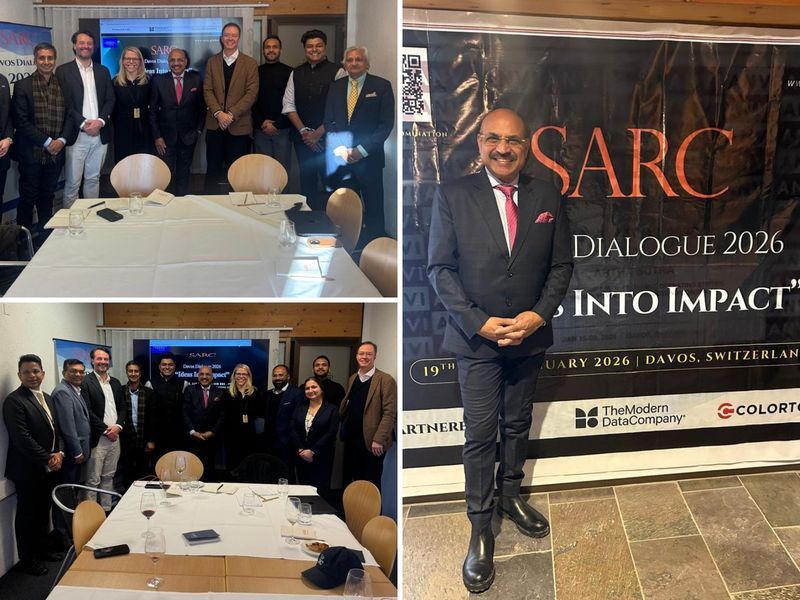
As geopolitical fragmentation, climate risk, and volatile capital flows unravel age-old economic certainties, SARC Global convened the "SARC Davos Dialogue 2026 — Ideas to Impact" at the World Economic Forum in Davos, Switzerland. Running from 19 to 23 January 2026, the Dialogues brought together visionary policymakers, industry leaders, global investors, and domain experts across five enriching days of closed-door roundtables and strategic discussions, all chaired by Sunil Kumar Gupta, Chairman and Global Leader of SARC Global.
Eight Critical Themes
The SARC Davos Dialogues 2026 successfully organised Leadership Roundtables on eight critical themes: Capital in a Fractured World; Strategic Autonomy vs Global Interdependence; Trade, Sanctions, and the Shadow Economy; India as the Next Supply-Chain Operating System; Competitive Federalism — Which Indian States Will Win the Next Decade?; Regulatory Certainty as a Growth Asset; Uttar Pradesh as a National Growth Engine — Viksit UP @2047; and State Capacity and Long-Term Growth — Telangana in the Viksit Bharat @2047 Journey.
Day One: Capital and Strategic Autonomy
Day One opened with two strategically linked roundtables centred on capital allocation and strategic autonomy. The session on "Capital in a Fractured World" highlighted the need to ground long-term investment in resilience and system-level credibility in a time of persistent geopolitical stress. India emerged as a primary reference point for system-led investability in a globally fractured economy. Participants explored how sovereign wealth repositioning, supply-chain de-risking, and regulatory clarity are redefining where capital flows — and why.
The roundtable on "Strategic Autonomy vs Global Interdependence" reinforced that strategic autonomy must be calibrated rather than ideological. A sector-specific lens revealed that energy, semiconductors, pharmaceuticals, food systems, defence, and digital infrastructure require higher resilience, while other sectors continue to benefit from global integration.
Strategic autonomy must be calibrated rather than ideological - the question is not whether to integrate, but where resilience must come first.
Day Two: Trade, Sanctions, and Competitive Federalism
Day Two featured focused discussions on trade controls, sanctions dynamics, and compliance architecture reshaping global commerce. The roundtable on "Trade, Sanctions, and the Shadow Economy" examined how excessive sanctions and over-compliance often push trade underground, expanding the shadow economy. In contrast, India's approach emphasises formalisation rather than exclusion, combining trade regulation, compliance capacity, and strategic restraint.
The "Competitive Federalism" roundtable assessed how sub-national execution, regulatory certainty, and infrastructure readiness will determine India's ability to convert global trade re-routing into durable economic advantage.
Technology at the Core: DataOS and Zero Trust
At the heart of the Davos Dialogues, SARC convened a series of high-impact roundtables showcasing an end-to-end solution for state-level data management through DataOS, developed by The Modern Data Company (TMDC). The discussions demonstrated how integrated data architectures can strengthen public finance management, improve scheme execution and monitoring, enable real-time data-driven decision-making, and significantly reduce operational friction across departments.
In partnership with ColorTokens, SARC also presented Zero-Trust-based micro-segmentation and breach-containment cybersecurity frameworks, critically relevant for data centres, cloud infrastructure, OT/SCADA systems, and government digital platforms. The convergence of governed data, AI-readiness, and resilient cybersecurity was framed as indispensable to scaling digital governance.
Explore how SARC's Technology Practice can support your organisation's digital transformation journey.
Our advisory team is ready to help.
Uttar Pradesh and Telangana: State-Led Growth Models
Uttar Pradesh and Telangana took centre stage as exemplars of India's state-driven approach to achieving Viksit Bharat @2047. The dialogue on Uttar Pradesh focused on the state's roadmap for the coming decades, positioning infrastructure-led growth, industrial expansion, and integrated urban-rural development as the central pillars of its economic transformation. The Telangana session explored state capacity and long-term growth, examining how institutional resilience and administrative agility drive sustainable development outcomes.
The roundtables featured contributions from a distinguished roster of participants including Rajendra S. Bagade, Senior Partner at SARC; Probir Roy, Global Lead for Fintech, Gaming & Frontier Technologies at SARC; Ashutosh Verma, Leader for Technology and AI; Ankit Anand, Founding Partner of Riceberg Ventures; Balbir Singh, Senior Advocate at the Supreme Court of India; and Ranu Gupta, Co-Founder and CEO of SARC Global.
Closing Reflections
The SARC Davos Dialogues 2026 culminated in a strong reaffirmation of India's state-led development paradigm, positioning governance — innovative, accountable, and execution-oriented — at the core of the national vision for Viksit Bharat @2047. The deliberations crystallised a defining insight: the transition from aspiration to achievement is shaped not merely by policy articulation, but by disciplined execution, institutional resilience, and administrative agility at the state level.
"India's journey toward a Viksit Bharat @2047 is being carried forward by execution at scale — where compliance strengthens confidence, openness expands opportunity, and growth is built on systems designed to perform under stress." — Sunil Kumar Gupta, Chairman, SARC Global
The dialogues reaffirmed that governance today is no longer confined to policy formulation — it is an exercise in precision, accountability, and real-time decision-making. For SARC Global, the Davos Dialogues 2026 mark a defining chapter in championing practitioner-led, execution-driven discourse on the global stage.